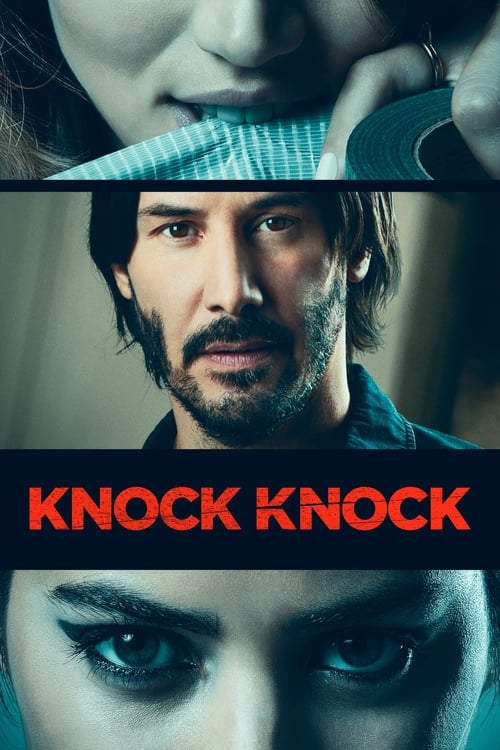
Here is the thing almost nobody notices about Knock Knock: it is a Father's Day movie. Not thematically, not if-you-squint. Literally. The whole nightmare is set in motion because it's Father's Day weekend and Evan Webber's family is leaving without him. His wife Karen, a sculptor, packs the two kids into the car for a beach trip while Evan, a successful architect with a busted shoulder and a deadline, stays behind in the gorgeous modernist house he presumably designed. The family drives off. The rain starts. And then somebody knocks.
The horror genre has built entire franchises out of Halloween and Christmas, and it has produced essentially nothing for Father's Day. The day comes around every year. Millions of people buy the card, grill the meat, hand Dad the novelty mug. And the one real movie sitting at the center of the occasion is a film almost everyone files under "erotic thriller" or "Keanu gets tortured by two hot women," as if the Father's Day setting were set dressing. It isn't set dressing. It's the entire argument. Knock Knock is the only film I know of that takes fatherhood seriously enough to put it on trial.
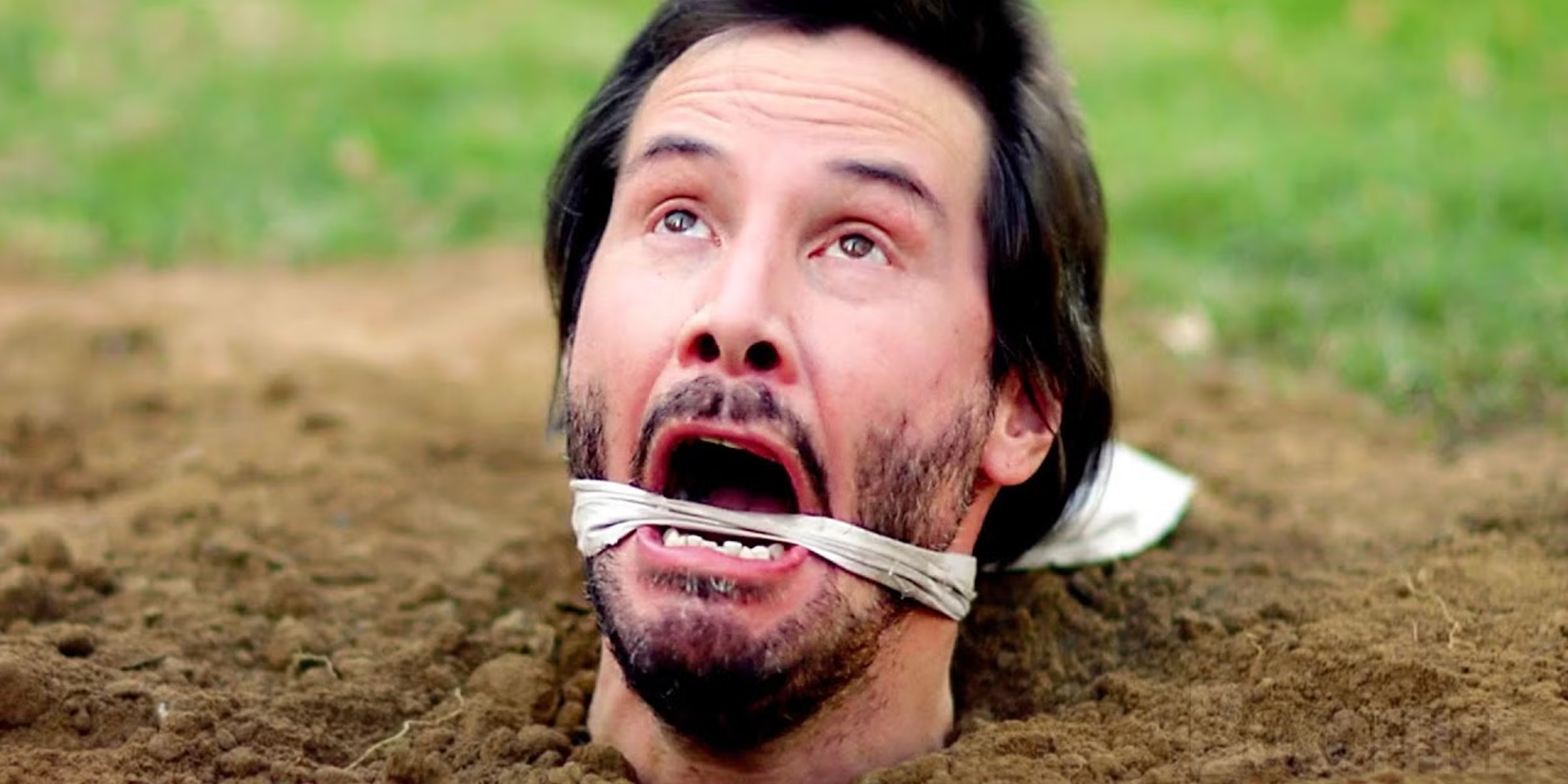
Let me back up. Two young women, Genesis and Bel, turn up at Evan's door soaked and lost, looking for a party. He's a good guy, so he lets them in to dry off and call a car. They flirt. He resists, really resists, for a surprisingly long stretch, and then he doesn't. The next morning the women refuse to leave. What follows is a slow, gleeful demolition: of his home, his marriage, his career, his sculpture (Karen's art, smashed), his sense of himself as a fundamentally decent man. By the end they've buried him in the garden and walked off to find the next house. The family comes home to a husband planted in the lawn like a lawn ornament of his own ruin.
Now. The feminist read here is more interesting than the one you'd expect, and it's more interesting than the one the movie thinks it's giving you. On its surface, Knock Knock plays like a cautionary tale a men's-rights forum would screenshot: beware the crazy women who will ruin your life over one mistake. Eli Roth is not the director you'd cast if you were trying to make a clean piece of feminist cinema. This is a man whose whole filmography leers, and the camera in Knock Knock leers right up until the moment it wants you to feel sick about leering. But that tension is exactly where the movie gets good. You have to do a little of that separating-the-art-from-the-artist work, and when you do, what surfaces is not a film about dangerous women. It's a film about a man discovering that his goodness was never tested, and therefore was never real, just circumstance wearing a wedding ring.
That's the part that makes it a Father's Day movie specifically, and not just a movie with infidelity in it. Father's Day is the holiday of the untested good dad. It is a day built entirely around affirming the ideal (the provider, the protector, the man who built the house and keeps everyone safe inside it) without ever once asking whether the ideal would survive contact with the actual man. We don't interrogate Dad on Father's Day. We thank him. Knock Knock is what happens when somebody finally interrogates him.
And it's relentless about the symbolism, which I respect the way I respect a $3,500 turkey puppet. Evan is an architect: he literally designed the structure of his domestic life, the patriarch who built the castle. The women don't just hurt him; they invade and desecrate every feminine space in the house: Karen's studio, the kids' rooms, the daughter's bedroom, her social media. The film keeps making you uncomfortable about the women's ages, daring you to notice that they're young enough to be his daughter, weaponizing the exact father-daughter dynamic the holiday sentimentalizes. And then there's the infamous scene where Evan, on trial in his own kitchen, defends himself with the immortal line about how it was free pizza. It was right there, it was free, what was he supposed to do. It's the funniest and bleakest moment in the movie because it's the whole male rationalization machine compressed into three words. The appetite was available, therefore the appetite was justified. The women laugh at him. So did I. So should you.
The ending is the thesis. They bury him alive in his own backyard, in the soil of the family life he's supposedly the head of, immobilized by the very domesticity he thought he presided over. The provider, planted. The protector, helpless. And the family drives home to find him (the daughter, the son, the wife) confronted with a monument to everything the Father's Day card refuses to say out loud: that the man at the head of the table is a man, with appetites and weaknesses and a capacity for self-deception, and that the ideal we celebrate every June is a costume, not a fact.
(For the record, this is a remake of Death Game, a 1977 film starring Sondra Locke and Colleen Camp, who produces Knock Knock and cameos in it. So the bones of this story are nearly fifty years old, which means men have been nervously telling this exact cautionary tale, and women have been in the room helping make it, for half a century. Make of that what you will. I make quite a lot of it.)
You probably won't watch this one with your dad. You definitely won't watch it for your dad. But that's the point. Every other Father's Day movie hands you the card. Knock Knock asks you to read the man behind it: the appetite, the rationalization, the house built on an ideal nobody ever stress-tested. Then it buries him in the yard and lets the family come home to the truth. The murder of the myth. The horror of the ordinary man. Happy Father's Day.