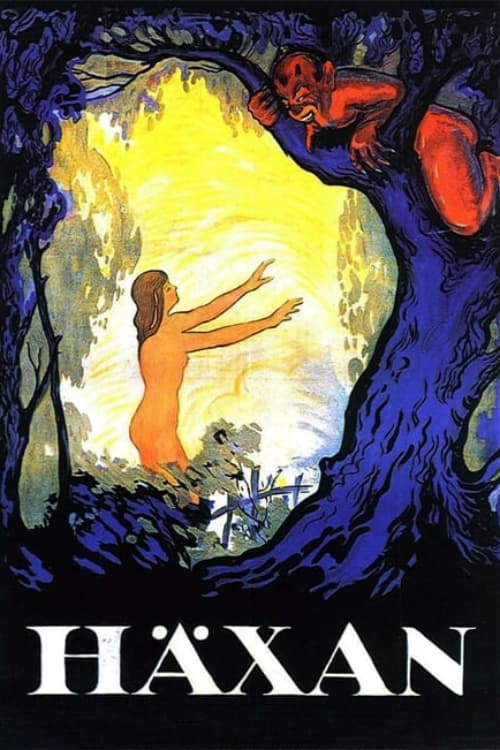
Häxan (1922) Part 1[edit] This geocentric model of the universe, similar to a model used in the film, depicts the Earth at the universe's center, surrounded by layers of air and fire, the Solar System, the stars, and finally God with choirs of angels. A scholarly dissertation on the appearances of demons and witches in primitive and medieval culture, the first segment of the film uses a number of photographs of statuary, paintings, and woodcuts as demonstrative pieces. In addition, several large scale models are employed to demonstrate medieval concepts of the structure of the Solar System and the commonly accepted depiction of Hell. Christensen attributes this medieval view of the universe to the research of Gaston Maspero, a famous egyptologist. Part 2[edit] The second segment of the film is a series of vignettes that theatrically demonstrate medieval superstition and beliefs concerning witchcraft, including Satan tempting a sleeping woman away from her husband's bed, terrorizing a group of monks, then murdering another woman in her bed by choking her. Also shown is a woman purchasing a love potion from a supposed witch named Karna in order to seduce a monk, and a supposed witch named Apelone dreaming of waking up in a castle, where Satan presents her with coins that she is unable to hold on to and festivities that she is unable to participate in. Parts 3–5[edit] Set in the Middle Ages, this narrative is used to demonstrate the treatment of suspected witches by the religious authorities of the time. A printer named Jesper dies in bed, and his family consequently accuses an old woman, Maria the weaver, of causing his death through witchcraft. Jesper's wife Anna visits the residence of traveling Inquisition judges, grasping one of their arms in desperation and asking that they try Maria for witchcraft. Maria is arrested, and after being tortured by inquisitors, admits to involvement in witchcraft. She describes giving birth to children fathered by Satan, being smeared with witch ointment, and attending a Witches' Sabbath, where she claims that witches and sorcerers desecrated a cross, feasted with demons, and kissed Satan's buttocks. She "names" other supposed witches, including two of the women in Jesper's household. Eventually, Anna is arrested as a witch when the inquisitor whose arm she grabbed accuses her of bewitching him. She is tricked into what is perceived as a confession, and is sentenced to be burned at the stake. Intertitles claim that over eight million women, men and children were burned as witches. Parts 6–7[edit] The final segments of the film seek to demonstrate how the superstitions of old have become better understood. Christensen offers the threat of medieval torture methods as an explanation for why many supposed heretics confessed to being involved in witchcraft. Though he does not deny the existence of the Devil, Christensen claims that those accused of witchcraft may have been suffering from what are recognized in modern times as mental or neurological disorders. A nun named Sister Cecilia is depicted as being coerced by Satan into desecrating a consecrated host and stealing a statue of the baby Jesus. Her actions are then contrasted with vignettes about a somnambulist, a pyromaniac, and a kleptomaniac. It is suggested that such behaviors would have been thought of as demonically-influenced in medieval times, whereas modern societies recognize them as psychological ailments (referred to in the film as hysteria). The film ends with a contrast between a woman being sent away to a mental institution and a scene where supposed witches burn on the stake. ^ Chisholm, Hugh, ed. (1911). "Maspero, Gaston Camille Charles". Encyclopædia Britannica. Vol. 17 (11th ed.). Cambridge University Press. p. 848. ^ .mw-parser-output cite.citation{font-style:inherit;word-wrap:break-word}.mw-parser-output .citation q{quotes:"\"""\"""'""'"}.mw-parser-output .citation:target{background-color:rgba(0,127,255,0.133)}.mw-parser-output .id-lock-free.id-lock-free a{background:url("//upload.wikimedia.org/wikipedia/commons/6/65/Lock-green.svg")right 0.1em center/9px no-repeat}.mw-parser-output .id-lock-limited.id-lock-limited a,.mw-parser-output .id-lock-registration.id-lock-registration a{background:url("//upload.wikimedia.org/wikipedia/commons/d/d6/Lock-gray-alt-2.svg")right 0.1em center/9px no-repeat}.mw-parser-output .id-lock-subscription.id-lock-subscription a{background:url("//upload.wikimedia.org/wikipedia/commons/a/aa/Lock-red-alt-2.svg")right 0.1em center/9px no-repeat}.mw-parser-output .cs1-ws-icon a{background:url("//upload.wikimedia.org/wikipedia/commons/4/4c/Wikisource-logo.svg")right 0.1em center/12px no-repeat}body:not(.skin-timeless):not(.skin-minerva) .mw-parser-output .id-lock-free a,body:not(.skin-timeless):not(.skin-minerva) .mw-parser-output .id-lock-limited a,body:not(.skin-timeless):not(.skin-minerva) .mw-parser-output .id-lock-registration a,body:not(.skin-timeless):not(.skin-minerva) .mw-pa…






User Comments
No comments yet. Be the first!